


How to Hit a Pickleball
Complete Guide to Pickleball Hitting Techniques: The Key to Mastering the Court
In the fast-growing, high-energy world of pickleball, mastering proper hitting techniques is the gateway to unlocking the sport’s true excitement—and to gaining the upper hand in competitive play. Every precise shot is a beautiful combination of body coordination, power management, and refined skill.
Let’s dive into the essential secrets of effective pickleball hitting.
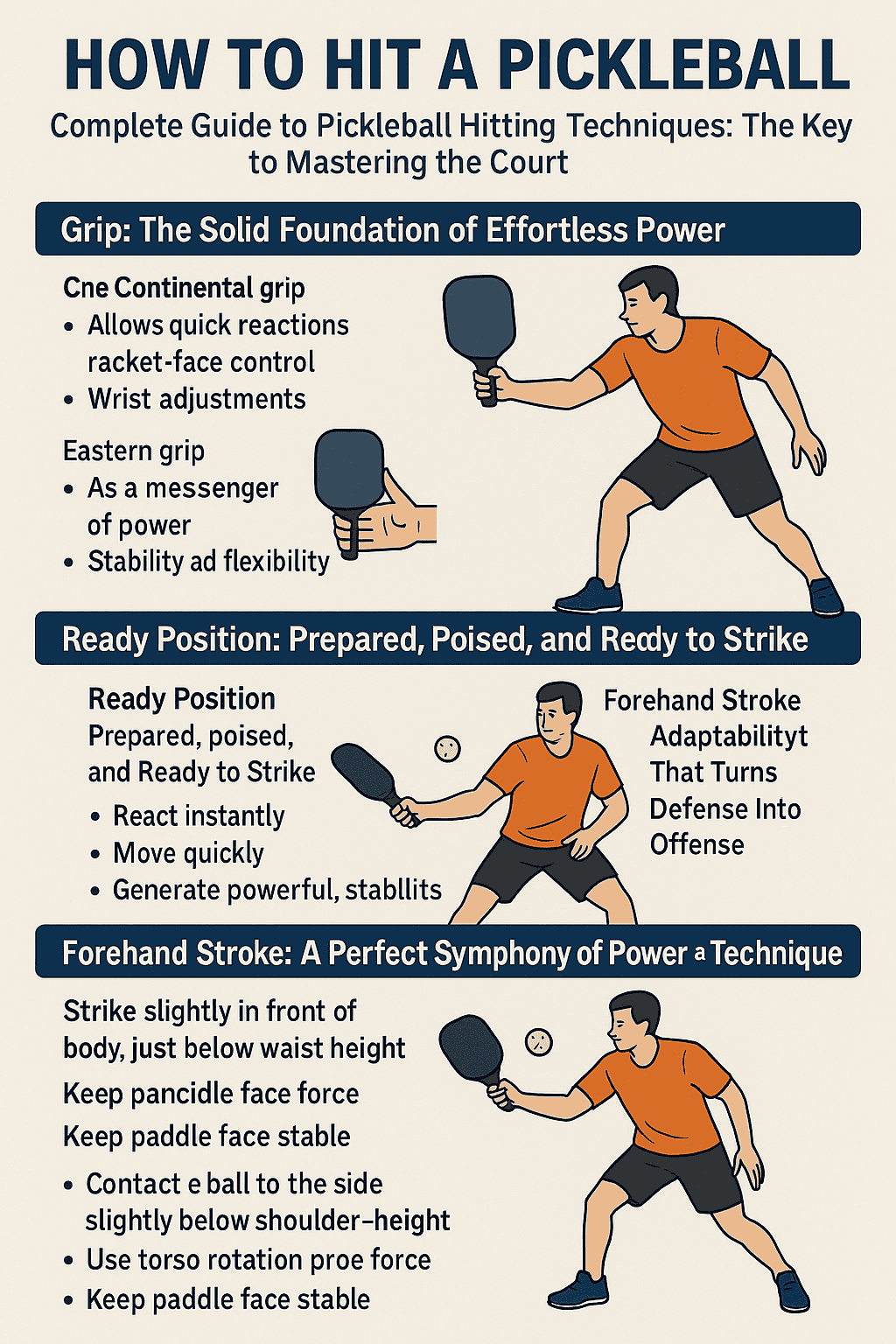
1. Grip: The Solid Foundation of Effortless Power
The grip is the starting point of all great shots. Two of the most common grips—the Continental grip and the Eastern grip—each offer unique advantages.
The Continental grip functions like a steady guardian.
It allows quick reactions at the net, excellent racket-face control, and smooth wrist adjustments. A subtle flick can send the ball gliding over the net, landing exactly where your opponent least expects it.
The Eastern grip behaves like a messenger of power.
From the baseline, it helps you channel the full strength of your arm and body. It’s like drawing back a bowstring and releasing explosive force at the moment of contact, sending the ball deep and fast into your opponent’s court.
Regardless of your choice, the key is balancing stability and flexibility, ensuring that power travels smoothly from your body through the paddle and into the ball with precision.
2. Ready Position: Prepared, Poised, and Ready to Strike
Before the ball even reaches your side, your body must be fully prepared.
Stand with feet shoulder-width apart, knees slightly bent, and body weight evenly distributed—like a leopard quietly crouched, ready to spring. Lean forward slightly, eyes locked on your opponent or the incoming ball, filtering out the world until only the ball remains.
Keep your arms relaxed, your paddle slightly back, and the paddle head held just above the wrist to maintain a flexible, energized stance.
This ready position allows you to:
react instantly
move quickly
generate powerful, stable hits
It is the calm before the explosive strike.
3. Forehand Stroke: A Perfect Symphony of Power and Technique
When the ball comes to your forehand side, a dynamic blend of technique and power begins.
Use quick footwork to position your body sideways, shifting weight onto your back foot (right foot for right-handed players). Like a coiled spring, your body loads up energy.
As the ball enters the optimal hitting zone, swing your arm forward and upward from the shoulder—smooth, powerful, and fluid, like drawing a sword.
At the same time, snap your wrist forward to accelerate the paddle head.
Key points:
Strike slightly in front of your body, just below waist height.
Fully extend your arm for maximum energy transfer.
Keep the paddle face vertical or slightly closed to control the shot’s direction.
Executed well, the ball can explode in a straight trajectory toward a deep corner—or arc gracefully with topspin, dropping sharply beyond the opponent’s reach.
4. Backhand Stroke: Adaptability That Turns Defense Into Offense
The backhand stroke requires quick reaction and precise body coordination.
When the ball heads to your backhand side, rotate your body while stepping outward with your right foot (for right-handed players). Draw the paddle back, turning your wrist so the paddle face points behind you.
As the ball enters the hitting zone, whip the paddle forward with a synced motion of your arm, wrist, and core rotation.
This combined movement increases both power and control.
Essential details:
Contact the ball to the side, slightly below shoulder height.
Let your torso rotation generate force.
Keep the paddle face stable to guide the ball cleanly over the net.
A well-executed backhand can flip a defensive moment into an aggressive opportunity—changing the tempo of the rally.
5. Hitting Rhythm: Balanced, Controlled, and Game-Changing
Mastering rhythm in pickleball is like conducting a musical masterpiece.
Too fast, and you lose control.
Too slow, and you miss offensive chances.
Adjust your rhythm according to the ball’s speed, height, and the game situation.
When the opponent sends a slow return:
→ Slow your rhythm, set up carefully, and strike with sudden acceleration to catch them off guard.
When the opponent sends a fast, powerful shot:
→ Increase your rhythm, use quick footwork, and meet the ball early—using their speed to your advantage.
Controlling rhythm is the key to controlling the match.
Conclusion
Pickleball hitting is a complete skill system requiring continuous refinement. From proper grip and stable preparation to powerful forehands, adaptable backhands, and dynamic rhythm control—each component is interconnected, forming the core beauty and challenge of the sport.
The more you practice, the more you’ll feel the subtle magic of each shot. Over time, you’ll master these techniques, dominate the court, and experience the passion, energy, and pure joy that pickleball brings.
BHI Pickleball-Custom Pickleball Paddle


