


Pickleball Court Construction Execution Plan
Building a Dynamic and Community-Focused Sports Facility
With the growing global emphasis on healthy and active lifestyles, pickleball has rapidly emerged as one of the most popular recreational sports due to its accessibility, competitiveness, and social appeal. The construction of professional pickleball courts plays a vital role in meeting public fitness demands and enhancing community engagement. The following implementation plan provides a clear, practical, and comprehensive guide for developing high-quality pickleball facilities.
1. Site Selection and Overall Planning
When selecting a site, priority should be given to areas with high accessibility, convenient transportation, and well-established surrounding amenities, such as public parks, school campuses, residential communities, or recreational centers. The selected location must offer sufficient space to accommodate standard pickleball courts while allowing for safety buffer zones to prevent stray balls and provide adequate circulation and spectator space.
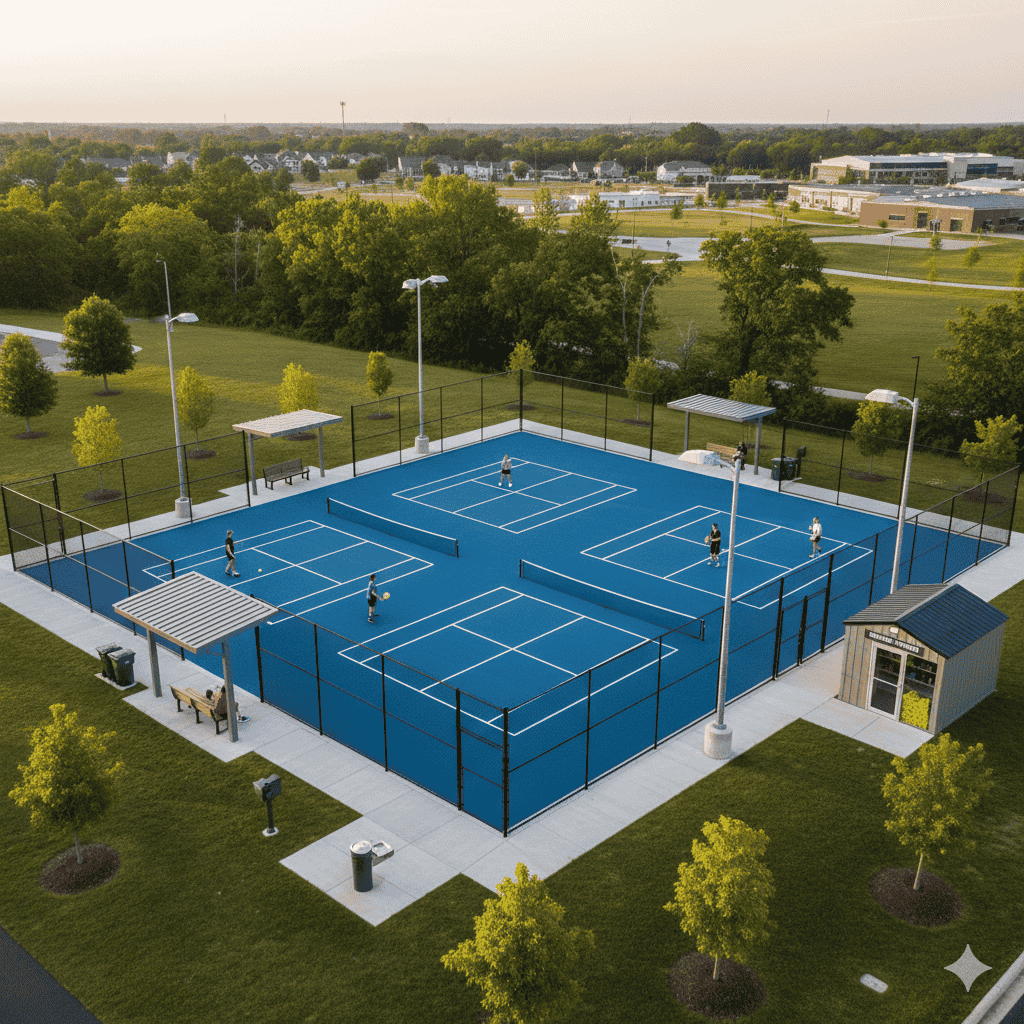
Based on the available land area, the number of courts and their layout should be planned efficiently. A standard pickleball doubles court measures 20 meters in length and 10 meters in width, while singles courts may be reduced to approximately 8 meters in width. Multiple courts can be arranged side by side, with protective netting installed between courts to minimize interference, improve safety, and enhance overall site organization and visual appeal.
2. Court Surface Construction
The playing surface is the foundation of a high-quality pickleball court. Professional sports surfacing materials are strongly recommended, with acrylic coatings being one of the most widely used and reliable options. Acrylic surfaces offer excellent durability, slip resistance, and weather adaptability, ensuring consistent performance and player safety.
Construction must begin with thorough ground leveling and compaction to create a solid, crack-free base. A resilient cushioning layer should be installed first to improve shock absorption and reduce injury risk. This is followed by multiple layers of acrylic coating, each applied evenly and allowed to cure fully. The final surface should provide optimal ball bounce, consistent friction, and a smooth playing experience that meets competition standards.
3. Fence Installation
Perimeter fencing serves as both a safety feature and a functional boundary. High-strength, corrosion-resistant materials such as galvanized steel mesh or polyethylene fencing are recommended, with a height of 3 to 4 meters to effectively prevent balls from leaving the court while maintaining airflow and visibility.
Fence posts must be securely anchored into the ground to ensure long-term structural stability. All joints and edges should be carefully finished to eliminate sharp points and reduce injury risks. Multiple access gates should be integrated into the fencing design to allow smooth player entry and exit, with simple locking mechanisms to secure the facility during organized events or off-hours.
4. Lighting System Design
To support play during early mornings, evenings, and nighttime hours, a well-designed lighting system is essential. Energy-efficient LED lighting should be installed evenly around the court perimeter to eliminate glare, shadows, and blind spots. Light pole heights typically range from 6 to 8 meters, depending on court size and lighting standards.
The lighting system should offer adjustable brightness levels to accommodate different usage scenarios and weather conditions. Special attention must be paid to minimizing light spill and disturbance to surrounding areas through proper fixture angles and shielding, ensuring that illumination remains focused within the playing area and creates a comfortable nighttime environment for players.
5. Supporting Facilities and Amenities
To enhance user comfort and overall facility functionality, a range of supporting amenities should be provided. These include seating benches, shaded rest areas or pavilions for players and spectators, drinking water stations, and waste disposal facilities to maintain cleanliness.
Additionally, a small equipment storage room can be incorporated to house pickleball paddles, balls, and related gear. This allows for convenient equipment management, rental or lending services, and proper maintenance, extending equipment lifespan and supporting efficient venue operations.
Conclusion
Through careful planning and professional execution, this pickleball court construction plan aims to create a safe, functional, and inviting sports environment. The completed facility will serve as a vibrant hub for recreation, competition, and social interaction, promoting physical activity and community engagement. By providing high-quality pickleball courts, communities, schools, and sports organizations can foster broader participation and allow more people to experience the unique enjoyment and long-term health benefits of pickleball.
BHI Pickleball-Custom Pickleball Paddle


