


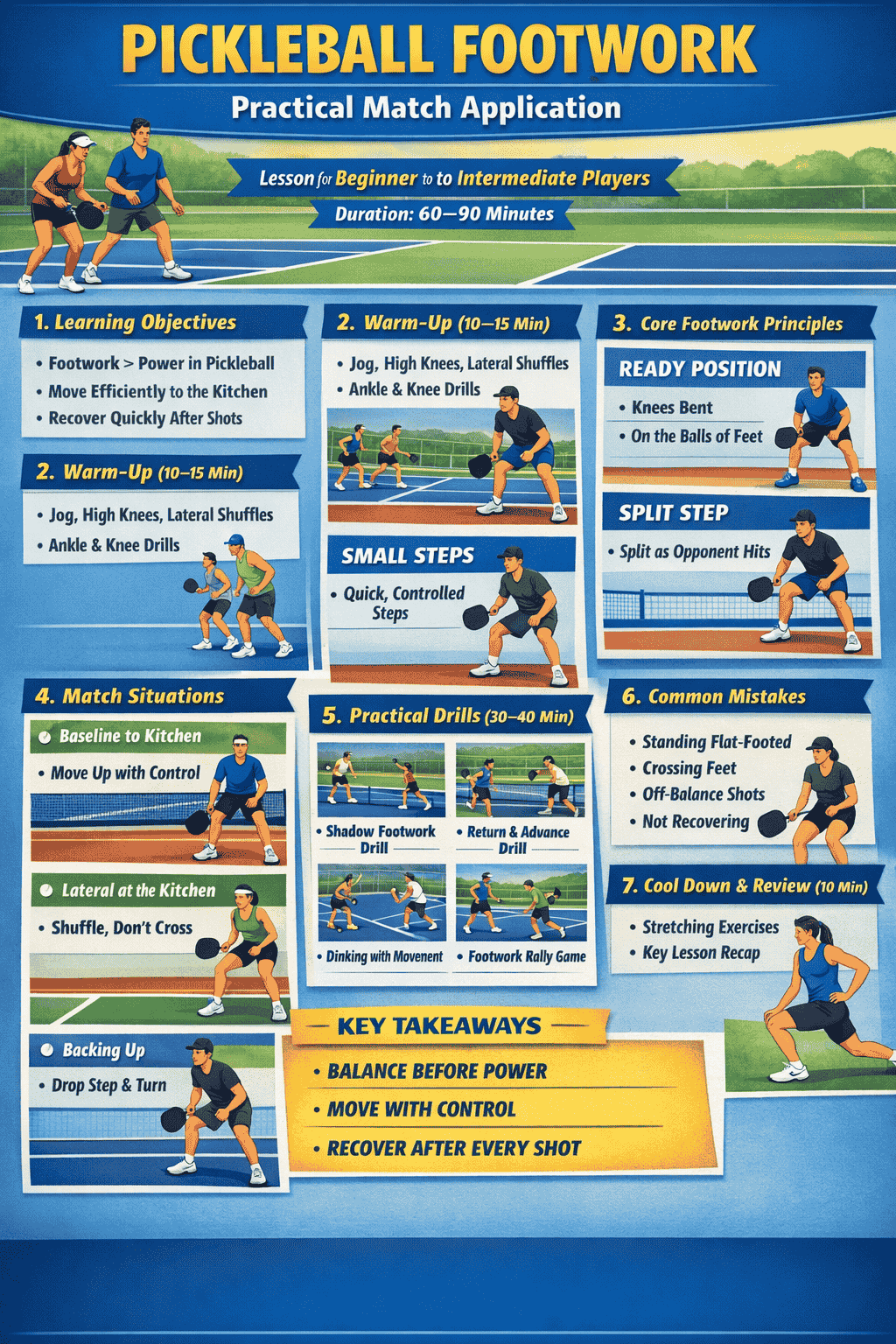
Pickleball Footwork: Practical Match Application
Teaching Lesson Plan
1. Lesson Overview
Lesson Title:
Pickleball Footwork – Practical Application in Real Matches
Target Level:
Beginner to Intermediate Players
Lesson Duration:
60–90 minutes
Main Objective:
Help players understand, practice, and apply correct pickleball footwork in real game situations to improve balance, positioning, reaction speed, and shot quality.
2. Learning Objectives
By the end of this lesson, players will be able to:
• Understand why footwork is more important than power in pickleball
• Use correct movement patterns during rallies
• Maintain balance while hitting shots
• Move efficiently to the Non-Volley Zone (Kitchen)
• Recover quickly after each shot
• Apply footwork skills in real match situations
3. Warm-Up (10–15 Minutes)
3.1 Dynamic Warm-Up
Purpose:
Activate legs, improve coordination, and prepare for lateral movement.
Exercises:
• Light jogging around the court (2 minutes)
• High knees and butt kicks (30 seconds each)
• Lateral shuffles (side-to-side)
• Forward and backward shuffles
• Ankle and knee mobility drills
Coaching Tip:
Remind players to stay light on their feet and avoid flat-footed movement.
4. Core Footwork Principles (Explanation)
4.1 Ready Position
Key Points:
• Knees slightly bent
• Feet shoulder-width apart
• Weight on the balls of the feet
• Paddle in front of the body
Why It Matters:
The ready position allows faster reaction and smoother movement in any direction.
4.2 Split Step
Explanation:
A small hop performed just before the opponent hits the ball.
Purpose:
• Improves reaction speed
• Helps players change direction quickly
Coaching Cue:
“Split when your opponent hits.”
4.3 Small Steps, Not Big Steps
Key Concept:
Pickleball requires quick adjustment steps rather than long strides.
Benefits:
• Better balance
• More consistent shot contact
• Faster recovery
5. Footwork in Common Match Situations
5.1 Baseline to Kitchen Movement
Scenario:
After the return of serve.
Correct Footwork:
• Hit the return
• Move forward immediately
• Use small, controlled steps
• Split step before opponent hits
Common Mistake:
Stopping at mid-court or running too fast and losing balance.
5.2 Lateral Movement at the Kitchen Line
Scenario:
Dinking rallies.
Correct Footwork:
• Side-step (shuffle), not crossing feet
• Stay low with bent knees
• Keep chest facing the net
Coaching Cue:
“Slide, don’t cross.”
5.3 Backward Movement for Deep Balls
Scenario:
Opponent hits a deep lob or drive.
Correct Footwork:
• Drop step with the outside foot
• Turn shoulders slightly
• Move back quickly, then set feet before hitting
Safety Tip:
Never run straight backward without turning the body.
5.4 Recovery Footwork After Each Shot
Key Principle:
Every shot should be followed by recovery.
Steps:
1. Hit the ball
2. Recover to neutral position
3. Perform a split step
Coaching Cue:
“Hit, recover, split.”
6. Practical Drills (30–40 Minutes)
6.1 Shadow Footwork Drill (No Ball)
Purpose:
Build movement habits without pressure.
Drill Description:
• Coach calls out directions: “Left,” “Right,” “Forward,” “Back”
• Players move using correct footwork and split step
6.2 Return-and-Advance Drill
Setup:
• One player serves
• One player returns and moves to the kitchen
Focus Points:
• Smooth forward movement
• Proper split step timing
6.3 Dinking with Footwork Focus
Rules:
• Only soft dinks allowed
• Players must maintain low stance
• Emphasize lateral shuffle
Goal:
Maintain balance while moving side to side.
6.4 Live Rally with Footwork Scoring
Game Rule:
• Points only count if player recovers to proper position after each shot
Purpose:
Encourage conscious footwork use during real play.
7. Common Footwork Mistakes to Correct
• Standing flat-footed
• Crossing feet at the kitchen line
• Hitting shots while off-balance
• Forgetting to recover after shots
• Rushing forward without control
8. Cool Down & Review (10 Minutes)
8.1 Stretching
• Calves
• Hamstrings
• Quads
• Hip flexors
8.2 Lesson Review Questions
Ask players:
• Why is footwork more important than power?
• When should you use the split step?
• What is the correct way to move at the kitchen line?
9. Key Takeaways
• Good footwork creates good shots
• Balance comes before power
• Move efficiently, not aggressively
• Every shot requires recovery
• Consistent footwork leads to consistent performanc
BHI Pickleball-Custom Pickleball Paddles


