


Pickleball Lesson Plan
Pickleball Lesson Plan: Embarking on an Energetic Sporting Journey
In today’s diverse sports landscape, pickleball has emerged as a fast-growing and highly engaging activity.
A well-structured pickleball lesson plan serves as the essential guide that helps enthusiasts step confidently into this exciting sport.
I. Establishing Teaching Objectives: Setting the Direction
Every effective pickleball lesson plan begins with clear teaching objectives.
Beginner Level
For newcomers, the primary goal is familiarization—understanding the basic equipment, learning how to grip the paddle, and getting to know the characteristics of the ball.
Students should quickly build foundational serving and receiving skills to develop confidence and control.
For example, an early objective may be for students to successfully complete 10 consecutive serves and achieve a receiving accuracy rate above 50%.
Intermediate Level
As students advance, the focus shifts toward improving tactical awareness and technical precision.
Learners practice using both forehand and backhand shots for offense and defense from various court positions. They also begin forming simple strategies, such as creating and exploiting open spaces by guiding opponents’ movement.
Advanced Level
Advanced training emphasizes refining competitive performance.
Students work on maintaining stable, high-quality skills under match pressure, mastering techniques such as volleys and smashes, and developing tactical flexibility—allowing them to adjust strategies quickly and effectively based on game situations.
II. Curriculum Structure: A Progressive Ladder of Learning
Instruction begins with an introduction to the history and development of pickleball to spark interest.
This is followed by lessons on court dimensions, boundary rules, and equipment selection, ensuring students understand the sport’s foundational setup.
Basic Skill Instruction
• Grip Technique
Coaches carefully correct hand placement to ensure stability and flexibility.
• Serving Skills
Training starts with simple underhand serves and gradually progresses toward more controlled and powerful variations. Key elements include power generation and ball placement.
• Receiving Skills
Students learn footwork, shot anticipation, and movement to ideal contact positions while focusing on paddle angle and power control.
Shot Techniques
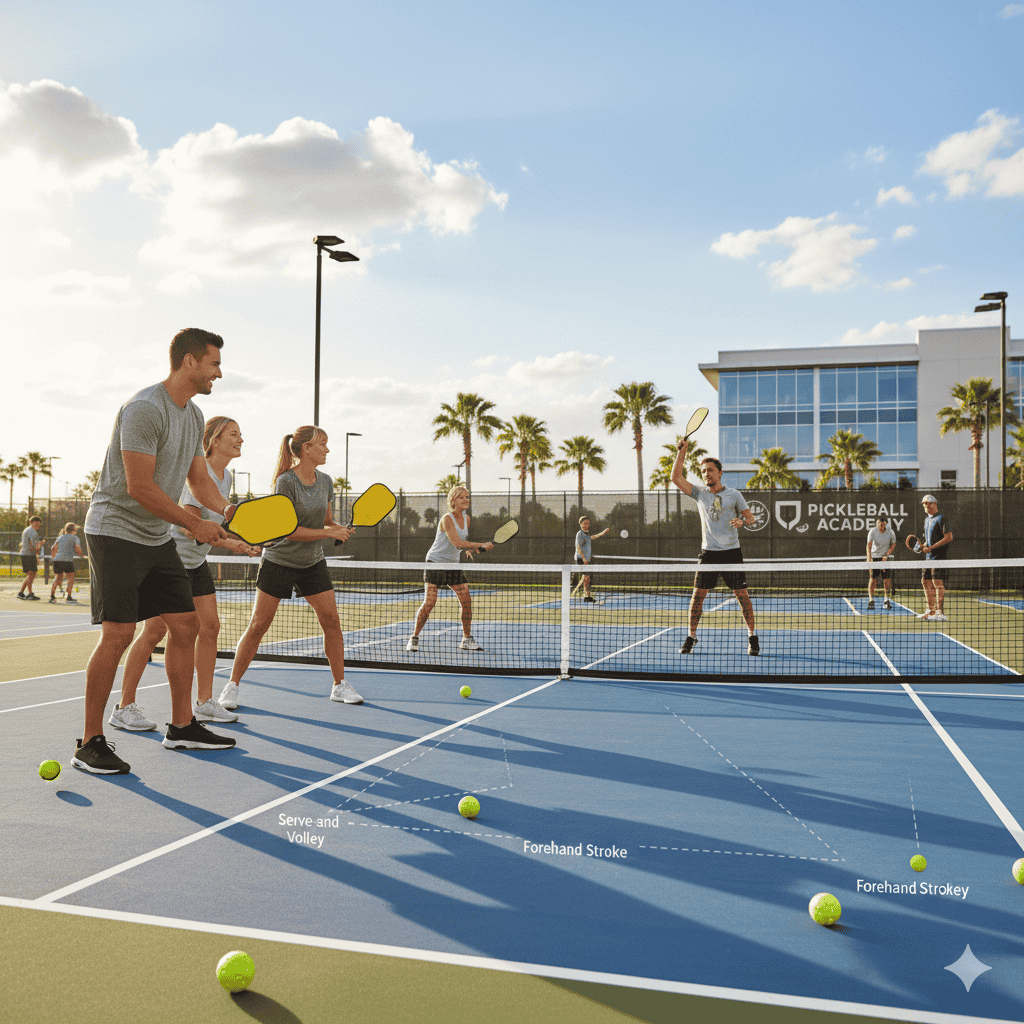
• Forehand Stroke
Emphasis on coordinated body rotation, smooth swing paths, and wrist acceleration.
• Backhand Stroke
One-handed and two-handed methods are taught to accommodate individual habits and physical strengths, helping each student find their most comfortable style.
Tactical Instruction
Tactics become essential at the intermediate and advanced levels.
Students explore singles strategies such as serve-and-volley or baseline defense and counterattacks, as well as doubles systems involving front-and-back or left-and-right formations.
Through scenario analysis and match simulations, learners gain insight into when and how to apply specific tactics.
III. Teaching Methods: Differentiated Instruction to Unlock Potential
Using a variety of teaching methods significantly enhances educational outcomes in pickleball.
Demonstration
Coaches visually demonstrate proper grip, serving, and shot techniques, giving students a clear reference for imitation.
Breakdown Drills
Complex movements such as serving or attacking shots are broken down into smaller components—ball toss, backswing, contact point—allowing students to gradually integrate them into a complete motion.
Group & Partner Practice
Paired drills encourage collaboration, feedback, and more efficient practice time while fostering teamwork.
Situational Training
Creating specific game scenarios—close scores, defensive plays, or pressure situations—allows students to apply tactics in realistic, game-like environments and develop practical decision-making skills.
IV. Evaluation and Feedback: Driving Continuous Improvement
Regular student assessments are a vital part of the teaching process.
Technical evaluations—such as serve accuracy, return consistency, and directional control—help determine progress. Meanwhile, observing students during simulated matches reveals their tactical execution, adaptability, and teamwork.
Providing constructive and timely feedback ensures balanced development:
• Praise and encouragement help motivated students continue striving.
• Targeted guidance assists those struggling in specific areas by offering tailored drills and correction plans.
Conclusion
A well-crafted pickleball lesson plan is like a carefully drawn navigation chart, guiding students smoothly across the ocean of pickleball skills—from beginners to confident, capable players.
It not only teaches technique and strategy but also ignites passion for the sport, encouraging greater participation and engagement.
BHI Pickleball -Custom Pickleball Paddle


