


Pickleball Instruction
Pickleball Instruction: Opening a New Chapter in an Energetic Sport
Among today’s many emerging sports, pickleball stands out with its unique charm, accessibility, and fast-growing popularity.
Systematic and professional pickleball instruction plays a vital role in helping enthusiasts swiftly grasp the essence of the game and master its techniques with confidence.
I. Foundational Knowledge: Building the Cornerstone of Pickleball Skills
Every effective learning journey begins with understanding.
At the start of pickleball instruction, it is essential to establish a solid knowledge framework for students.
By introducing the fascinating story of pickleball’s origins—how a simple backyard pastime evolved into a global sensation—students gain a sense of innovation and vitality that the sport embodies.
Next comes a clear, structured explanation of the rules. From court boundaries, serving regulations, and the non-volley zone, to legal hitting areas, coaches break down each rule with vivid examples and diagrams to ensure students gain a precise understanding.
Introducing the court layout and equipment is equally important. Students are guided to hold and feel the paddle, observe its material and grip, and understand how different paddles affect ball control. They examine the weight, holes, and bounce characteristics of the pickleball, learning how these factors influence flight behavior during play.
This stage is like opening the door to the world of pickleball—inviting students to step in with curiosity and excitement.
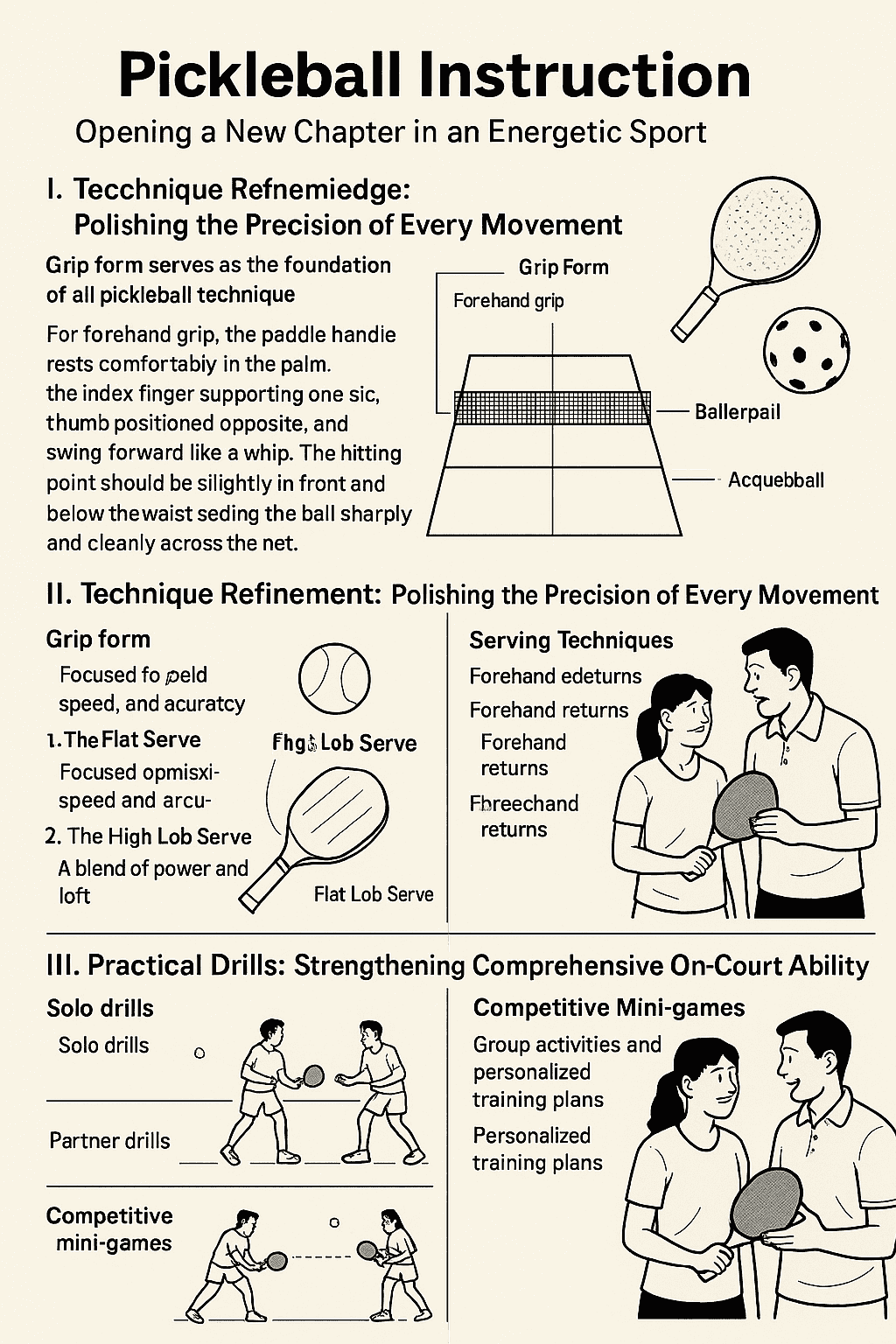
II. Technique Refinement: Polishing the Precision of Every Movement
Grip form serves as the foundation of all pickleball technique.
For the forehand grip, the paddle handle rests comfortably in the palm, the index finger supporting one side, the thumb positioned opposite, and the remaining fingers wrapping naturally to maintain stability and flexibility.
The backhand grip is an effortless transition—students adjust the thumb toward the bottom of the handle and allow the index and middle fingers to guide the upper edge, enabling powerful and accurate backhand strokes.
Serving instruction highlights two essential techniques:
1. The Flat Serve
Focused on simplicity, speed, and accuracy.
Students stand with staggered feet, lean forward slightly, toss the ball to chest height, draw the paddle back smoothly, and swing forward like a whip. The hitting point should be slightly in front and below the waist, sending the ball sharply and cleanly across the net.
2. The High Lob Serve
A blend of power and loft.
The backswing lifts high, the wrist loads power, and after a controlled toss, the ball is struck with a strong upward motion to create a graceful, high arc aimed at the opponent’s backcourt.
Receiving techniques are equally emphasized.
Forehand returns require observation, quick footwork, and a smooth backswing, followed by a controlled arm-and-wrist action. Backhand returns involve rotating the body sideways, adjusting wrist angles, and releasing force precisely at impact.
Throughout the process, the coach demonstrates each movement clearly, offers detailed explanations, and provides one-on-one corrective feedback, helping students internalize every skill through deliberate practice.
III. Practical Drills: Strengthening Comprehensive On-Court Ability
Once students grasp foundational technique, they progress to practical drills to enhance real-game performance.
Solo drills allow students to self-assess and reinforce skills—repeating serves into target zones, returning their own shots, and continuously refining the control of angles, power, and tempo.
Partner drills introduce interaction and dynamic play.
Baseline exchanges test both players’ ability to apply serving and returning skills while improving anticipation, court movement, and tactical awareness.
Competitive mini-games further activate learning:
Serving accuracy challenges sharpen control and technique under pressure.
Team relay rallies encourage cooperation, quick decision-making, and stable performance even in fast-paced exchanges.
IV. Continuous Growth: Guiding Students on Their Pickleball Journey
Pickleball instruction is not merely a teaching session—it is an ongoing journey of growth.
Coaches focus not only on skill advancement but also on cultivating enthusiasm, confidence, and perseverance. Regular group activities allow students to share insights, support each other, and progress together.
Personalized training plans help students continue improving outside class, offering targeted recommendations based on their strengths and weaknesses.
Under consistent and thoughtful guidance, students grow from complete beginners into confident players who move freely and joyfully on the court. Some may even gain the potential to shine in future competitions.
Pickleball instruction will continue to evolve and inspire—opening the door for more people to experience a sport full of energy, challenge, and happiness, guiding them toward a healthier and more active lifestyle.
BHIPickleball


