


Pickleball Basic Teaching Practice Lesson Plan
I. Teaching Objectives
1. Introduce students to the fundamentals of pickleball, including its origins, rules, court layout, and equipment.
2. Help students master essential techniques such as grip, serving, and receiving.
3. Improve students’ body coordination, reaction speed, and hand-eye coordination through instruction and practice.
4. Cultivate interest in pickleball, encourage communication and cooperation among students, and enhance teamwork.
II. Teaching Focus and Difficulties
1. Key Teaching Focus
• Correct grip technique, including forehand and backhand grips.
• Stable and effective serving techniques (flat serve, high clear serve).
• Basic receiving techniques, including forehand and backhand returns, and proper footwork.
2. Teaching Difficulties
• Accurately judging the direction, speed, and landing point of incoming shots, and responding appropriately.
• Controlling power and shot angle to ensure accurate placement into the opponent's effective playing area.
• Developing teamwork and synergy during pair or group activities.
III. Teaching Methods
1. Explanation & Demonstration: Provide clear verbal instructions and demonstrate movements to help students visualize correct technique.
2. Progressive Practice (Breakdown Method): Decompose complex skills into simple steps to practice progressively before integrating into full movements.
3. Game-Based Learning: Use mini-games and competitions to increase interest, engagement, and challenge.
4. Individual Guidance: Observe each student and give personalized corrections to address mistakes or difficulties.
IV. Teaching Preparation
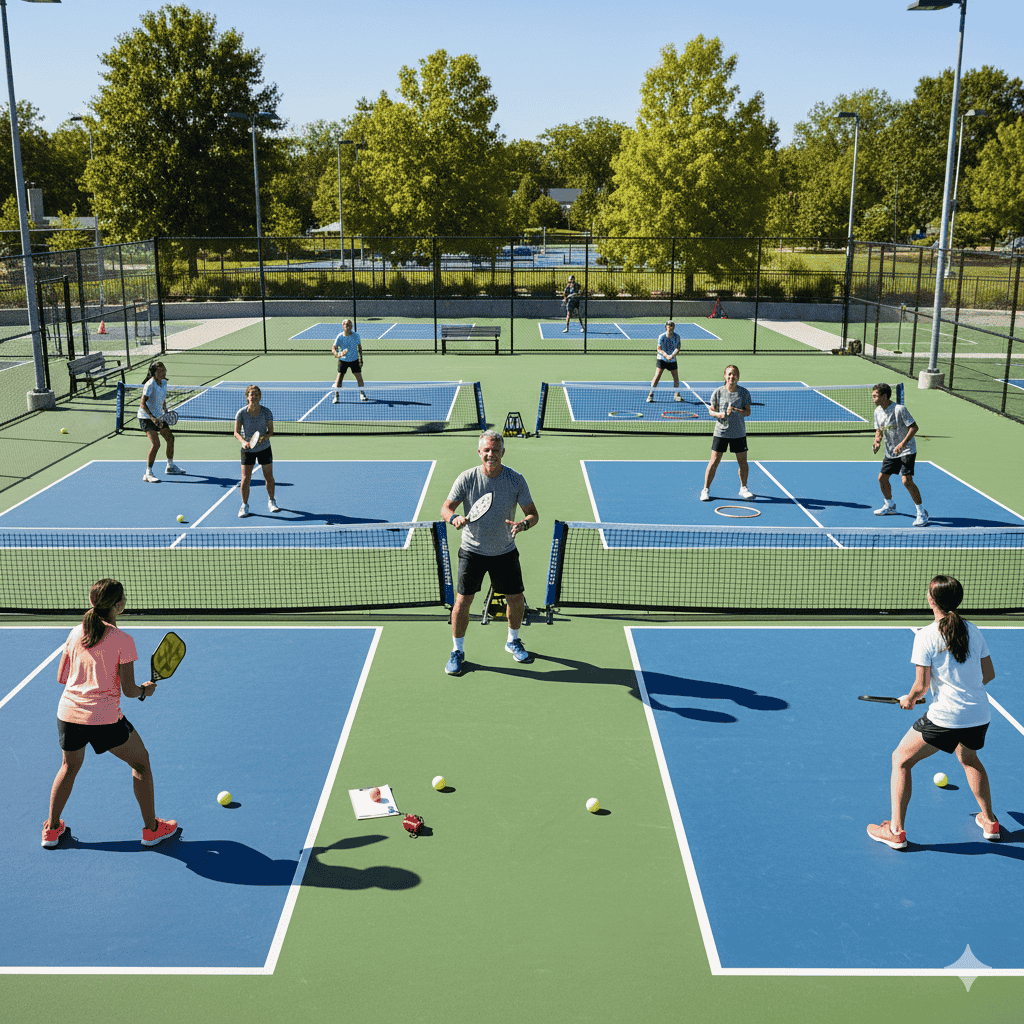
1. Multiple pickleball courts arranged according to the number of students.
2. Sufficient paddles and pickleballs so every student can participate in practice.
3. Teaching aids such as markers, cones, and whistles for class organization and game setup.
V. Teaching Process
(I) Course Introduction – 10 minutes
1. Gather students, have them introduce themselves, and welcome them to the course.
2. Ask students about their understanding of pickleball and use this to introduce:
• Origins: How pickleball developed from a backyard family activity into a popular sport.
• Characteristics: Highlight features borrowed from tennis, badminton, and table tennis; emphasize its smaller court, slower ball speed, and beginner-friendly nature.
(II) Basic Knowledge Explanation – 10 minutes
1. Rules Overview
• Court Layout: Singles and doubles court dimensions, boundary lines, service areas.
• Serving Rules: Serving order, legal serving technique, valid serve zones, and common faults (e.g., foot faults, overhand serve violations).
• Hitting Rules: Hitting constraints, double-bounce rule, net rules, and when faults occur.
• Scoring Rules: Situations that award points, such as missed returns, out-of-bounds shots, and fouls.
2. Court and Equipment Introduction
• Court Tour: Walk students around the court and explain net height, surface type, and designated areas.
• Equipment Overview: Show paddles and balls; explain materials, paddle structure, grip size, and ball characteristics, and how these affect gameplay.
(III) Basic Skills Instruction – 30 minutes
1. Grip Technique – 5 minutes
Forehand Grip
• Demonstration:
Hold the paddle naturally with the index finger curved on one side and the thumb on the other, keeping the paddle face perpendicular to the ground.
• Practice:
Students imitate the teacher; teacher walks around correcting grip posture.
Backhand Grip
• Demonstration:
Rotate the paddle slightly outward from forehand grip; thumb presses behind the handle, index and middle fingers rest on top.
• Practice:
Students practice and compare differences between forehand and backhand grips.
2. Serving Techniques – 10 minutes
Flat Serve
• Movement Breakdown:
Staggered stance, slight forward lean, gentle ball toss to chest height, backswing with relaxed wrist, forward swing to make contact slightly in front of the body.
The ball travels in a relatively flat trajectory.
• Practice:
Groups of 3–4; each student serves 10 times. Instructor checks toss height, contact point, posture, and power.
High Clear Serve
• Instruction:
Similar to flat serve but with higher backswing and upward follow-through to produce a high arcing shot landing near the back baseline.
• Practice:
Students serve 10 high clear serves each. Teacher corrects issues like insufficient arc or inaccurate placement.
3. Receiving Techniques – 15 minutes
Forehand Receiving
• Demonstration:
Move quickly to position, backswing with racket arm bent, contact the ball in front of the body with a forward swing.
• Practice:
Students work in pairs—one serves, one receives—performing 10 repetitions before switching roles.
Backhand Receiving
• Demonstration:
Turn sideways to the ball, adjust footwork, draw racket back, and hit with the backhand side while keeping the arm straight at impact.
• Practice:
Students perform backhand returns in groups; teacher focuses on grip, body rotation, and shot effectiveness.
(IV) Practice & Consolidation – 20 minutes
1. Individual Fixed-Point Drills – 10 minutes
• Students practice:
• 10 flat serves
• 10 high clear serves
• Receiving their own serve and returning the ball to a designated target area
• Focus: correct form, power control, shot accuracy.
• Instructor circulates to monitor and correct mistakes.
2. Doubles Rally Practice – 10 minutes
• Students pair up; one serves, the other receives, then both attempt to maintain a continuous rally.
• Focus: applying techniques learned, adjusting position, improving control and consistency.
• Instructor provides feedback on coordination, movement, and shot selection.
(V) Game Competitions – 15 minutes
1. Serving Accuracy Competition – 8 minutes
• Divide students into groups of 4–5.
• Set target zones worth different points (5–3–1).
• Each student serves 5 balls; score based on landing area.
• Highest total score wins.
• Purpose: enhance serving accuracy, consistency, and teamwork.
2. Group Relay Rally Game – 7 minutes
• Groups of 3–4 stand in lines on each baseline.
• First player serves; opponent returns; player moves to back of line; next student continues the rally.
• Group with the most successful rallies wins.
• Purpose: improve receiving, rally control, teamwork, and coordination.
(VI) Course Summary & Cool-Down – 5 minutes
1. Instructor gathers students to review key points:
• Pickleball basics, grips, serving, receiving, strengths and weaknesses observed.
• Encouragement to continue practicing.
2. Lead simple cool-down routines: deep breathing, arm/leg stretches to relieve fatigue and close the session in a relaxed atmosphere.
VI. Teaching Evaluation
1. Observe class performance: participation, attitude, and skill mastery. Provide timely correction.
2. Record data during practice and games, such as serving accuracy, receiving success rate, and rally counts. Use data to evaluate improvement.
3. After class, gather student feedback to refine future teaching methods and improve instructional quality.
BHI Pickleball-Custom Pickleball Paddle


