


Pickleball Court Standard Dimensions and Costs
A Complete Analysis of Court Specifications and Construction Expenses
As pickleball continues its rapid rise in global popularity, understanding the standard court dimensions and the associated construction costs has become essential for players, venue operators, investors, and industry professionals.
Accurate knowledge not only ensures that courts meet official standards but also directly impacts gameplay quality, user experience, and overall project budgeting.
I. Standard Dimensions of a Pickleball Court
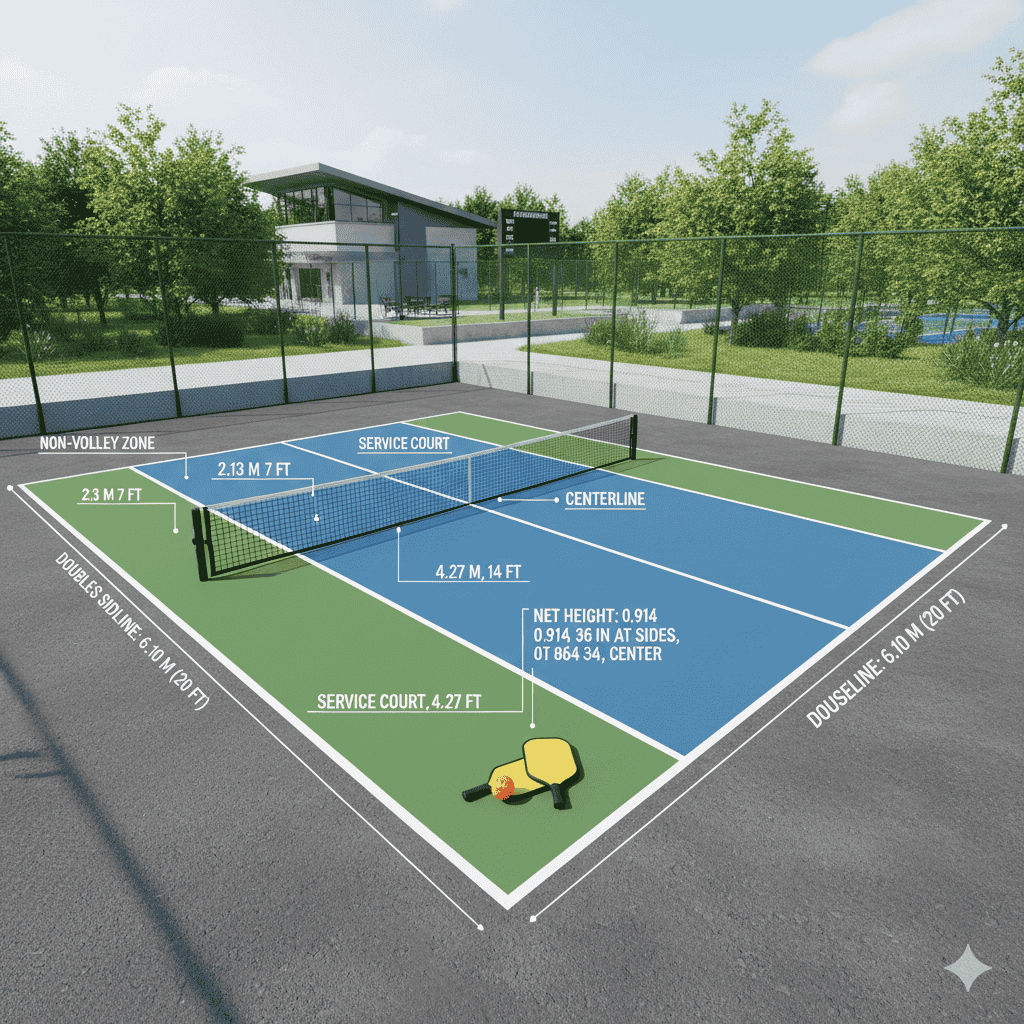
A pickleball court is rectangular, and the official dimensions are:
• Singles Court: 13.41 meters long × 5.49 meters wide
• Doubles Court: 13.41 meters long × 6.10 meters wide
In addition to the main playing area, a buffer zone surrounding the court is required for safety and mobility. This extra space prevents injuries caused by running into surrounding walls or equipment during intense play.
Compared to other racquet sports, the size of a pickleball court falls between that of a tennis court and a badminton court.
This thoughtful design provides:
• Adequate space for shot variety, quick footwork, and tactical play
• A comfortable playing environment without excessive physical fatigue
• Balanced difficulty suitable for players of all ages and skill levels
In singles play, athletes can utilize the court’s length for offensive and defensive transitions, using precise shots to control their opponent’s positioning.
In doubles, the slightly wider layout encourages teamwork, strategic positioning, and coordinated attacks.
II. Major Factors Affecting Pickleball Court Construction Costs
1. Ground Preparation
Ground leveling and compaction form the foundation of any new court.
Costs vary depending on the original condition of the site:
• Normal leveling: 30–50 RMB per square meter
• If additional reinforcement is needed (uneven or soft soil): 80–120 RMB per square meter
A flat, well-compacted base ensures court longevity and optimal surface performance.
2. Surface Material Options
Different flooring materials significantly affect the overall cost, maintenance needs, and user experience.
(1) Acrylic Surface
• Cost: 80–150 RMB/m²
• Benefits: Durable, anti-slip, vivid colors, budget-friendly
• Considerations: May become brittle in cold climates; requires periodic maintenance
• Best For: Community courts, schools, budget projects
(2) Sports Wood Flooring
• Cost: 300–500 RMB/m²
• Benefits: Excellent elasticity, premium playing feel, ideal for professional use
• Considerations: Higher cost, requires expert installation
• Best For: Indoor clubs, training centers, professional venues
(3) Artificial Turf
• Cost: 150–250 RMB/m²
• Benefits: Good shock absorption, attractive appearance, easy maintenance
• Considerations: Possible odor in high temperatures, shorter lifespan than wood flooring
• Best For: Outdoor recreational courts, community facilities
3. Supporting Facility Costs
(1) Pickleball Net System
• Nets: 300–800 RMB depending on material and durability
• Posts and Fixing Hardware: 500–1,000 RMB
(2) Court Lighting
Essential for nighttime or indoor play.
• Complete lighting setup: 5,000–20,000 RMB
(Cost varies by court size, brightness requirements, and installation complexity)
(3) Fencing
Fences (typically 3–4 meters high) prevent ball loss and enhance safety.
• Wire mesh fencing: 80–150 RMB per meter
• Plastic-coated steel fencing: 150–250 RMB per meter
III. Comprehensive Planning and Considerations
When planning a pickleball court project, several factors must be assessed holistically:
1. Court Usage and Target Audience
• For schools, parks, and community centers:
Cost-effective acrylic or artificial turf surfaces are typically preferred to meet basic needs while staying within budget.
• For commercial sports clubs or tournament venues:
Higher-end surfaces like professional sports wood flooring enhance experience, attract players, and support long-term revenue.
2. Functional and Environmental Design
Court planning should consider overall venue layout and amenities, such as:
• Rest areas
• Changing rooms
• Spectator seating
• Equipment storage
• Safety pathways and signage
These features enhance player comfort, improve venue efficiency, and create a more enjoyable experience for both athletes and spectators.
Conclusion
Understanding the standard dimensions and construction costs of pickleball courts provides a solid foundation for making informed decisions—whether building a simple community court or a full-scale professional venue.
With proper planning and budget allocation, pickleball courts can be constructed to deliver excellent performance, safety, and long-term value, helping the sport grow and flourish in a suitable and well-designed environment.
BHI Pickleball-Custom Pickleball Paddle


